←
Back to insights
1 min read
•
145 words
AI Agent Coding Tip (for real-world engineering)
AN
Ablikim Nur
•
1 min read
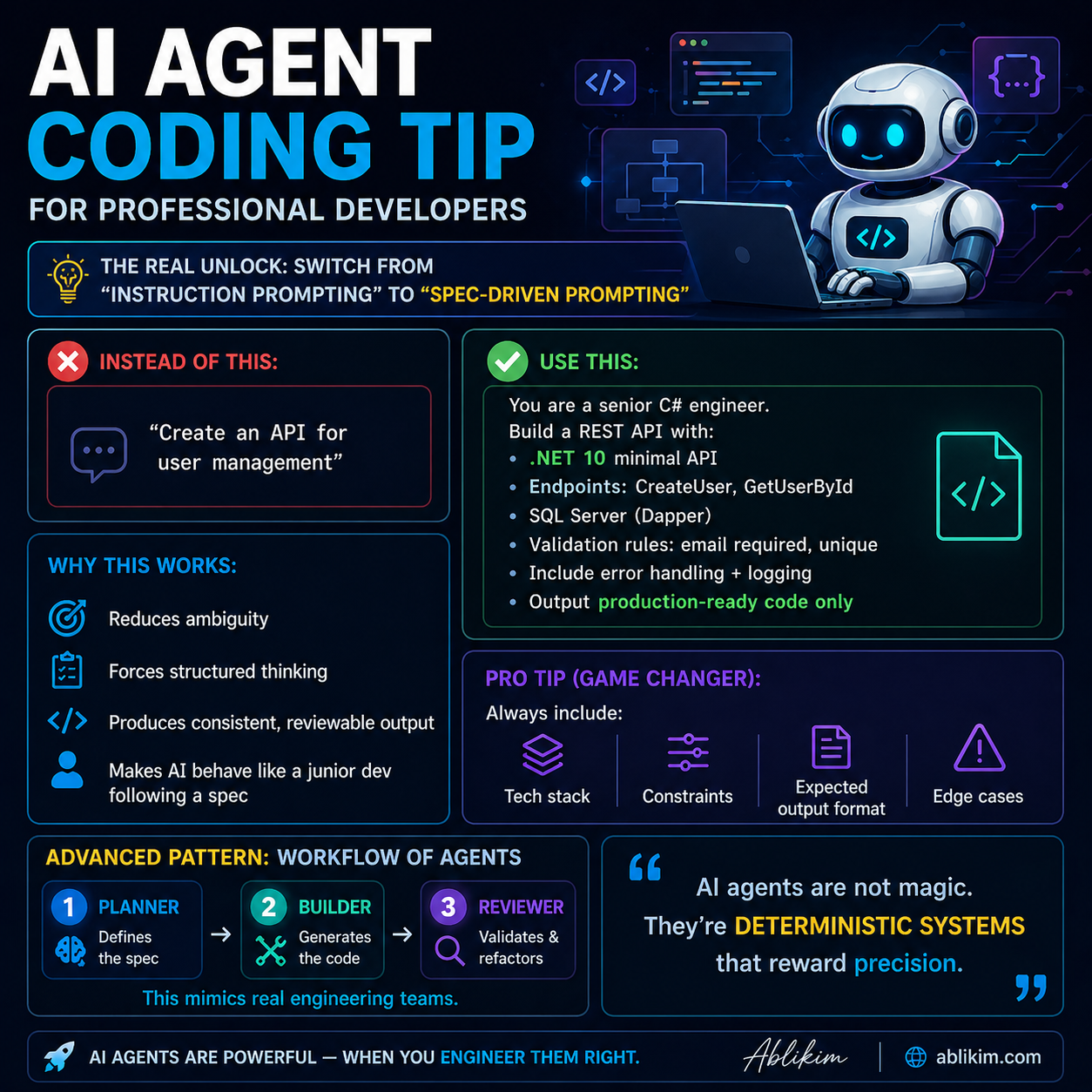
💡 AI Agent Coding Tip (for real-world engineering)
Most developers use AI agents like this:
👉 “Build me a feature…”
And then wonder why the output is inconsistent.
🔥 The real unlock:
👉 Switch from “instruction prompting” → “spec-driven prompting”
Instead of this:
❌ “Create an API for user management”
Use this:
✅ “You are a senior C# engineer.
Build a REST API with:
- .NET 10 minimal API
- Endpoints: CreateUser, GetUserById
- SQL Server (Dapper)
- Validation rules: email required, unique
- Include error handling + logging
- Output production-ready code only”
🧠 Why this works:
- Reduces ambiguity
- Forces structured thinking
- Produces consistent, reviewable output
- Makes AI behave like a junior dev following a spec
⚙️ Pro tip (game changer):
👉 Always include:
- Tech stack
- Constraints
- Expected output format
- Edge cases
🚀 Advanced pattern:
Break your workflow into agents:
- Planner → defines spec
- Builder → generates code
- Reviewer → validates & refactors
👉 This mimics real engineering teams.
AI agents are not magic.
They’re deterministic systems that reward precision.
Curious — are you using spec-driven prompts or still ad-hoc prompting?
#AI #AIAgents #CSharp #SoftwareEngineering #DevTools #LLM