I started writing software before Stack Overflow existed.
20+ years in software engineering taught me one thing: technologies will keep changing, but the ability to **learn, adapt, and solve real problems** never loses value. From Delphi to .NET, cloud, microservices, and now AI—the tools evolve, but strong engineering fundamentals remain.
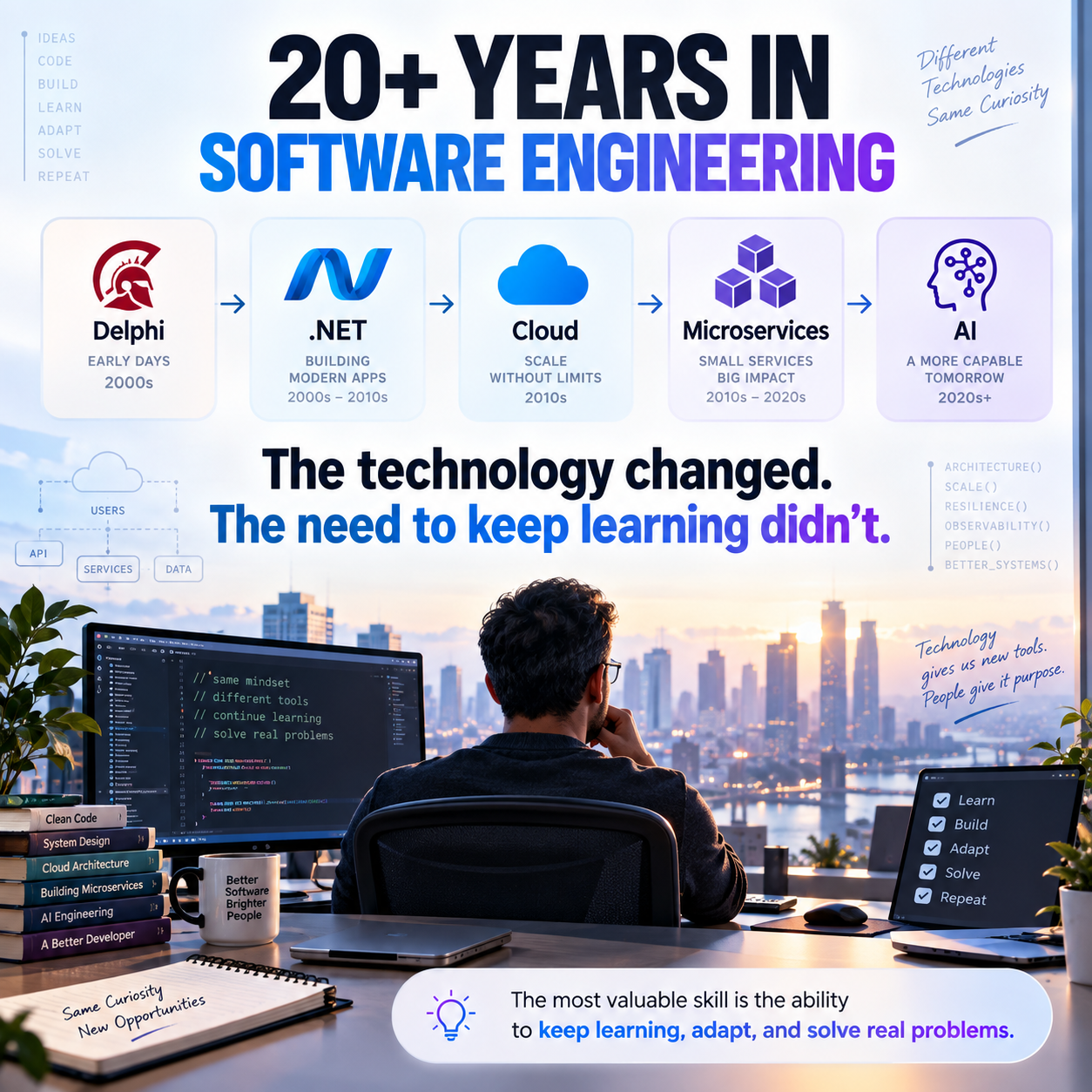
More than 20 years later, I'm still learning.
During that time, I've watched software development change again and again:
Delphi → C#
Desktop → Web
Monoliths → Microservices
On-premise → Cloud
Manual deployments → CI/CD
SQL everywhere → Polyglot persistence
REST APIs → Event-driven systems
And now…
Developers → Developers + AI
Every few years, we're told:
“This technology will change everything.”
Sometimes it does.
But after 20+ years in software engineering, I've noticed something interesting.
The technologies that made me valuable 15 years ago are not necessarily the technologies that make me valuable today.
But some skills survived every technology cycle:
1. Understanding the problem before writing the code
A perfectly implemented solution to the wrong problem is still the wrong solution.
2. Knowing where to draw boundaries
Classes. Modules. Services. Databases. Teams.
Architecture is often about deciding where one responsibility ends and another begins.
3. Debugging when the obvious answer is wrong
Production rarely fails exactly like the tutorial.
4. Understanding trade-offs
Performance vs maintainability.
Speed vs quality.
Build vs buy.
Microservices vs modular monolith.
SQL vs NoSQL.
There is almost never a universally “best” answer.
5. Being able to learn again
This may be the most important one.
I started with technologies that many developers today have never used.
Then came .NET.
Then cloud.
Then containers.
Then microservices.
Now AI.
And AI will not be the last major change in our industry.
That's why I no longer think a senior engineer is defined by:
“How many technologies do you know?”
I think it's closer to:
“How quickly can you understand a new problem, learn what you need, make good trade-offs, and build something that actually works?”
Technologies change.
Frameworks change.
Architectures change.
The ability to learn and solve problems survives all of them.
For engineers who have been in this industry for 10, 15, or 20+ years:
What skill has remained valuable throughout your entire career?
#SoftwareEngineering #SoftwareArchitecture #DotNet #CSharp #Programming #Developers #TechCareers #EngineeringLeadership #ArtificialIntelligence