AWS SNS/SQS vs EventBridge: The Choice Every Microservices Architect Has to Make
In AWS microservices architecture, SNS/SQS and EventBridge solve different messaging problems. SNS/SQS is ideal for reliable asynchronous work, buffering, retries, and fan-out, while EventBridge is better for loosely coupled domain events and intelligent event routing—and in many production systems, the strongest architecture uses both together.
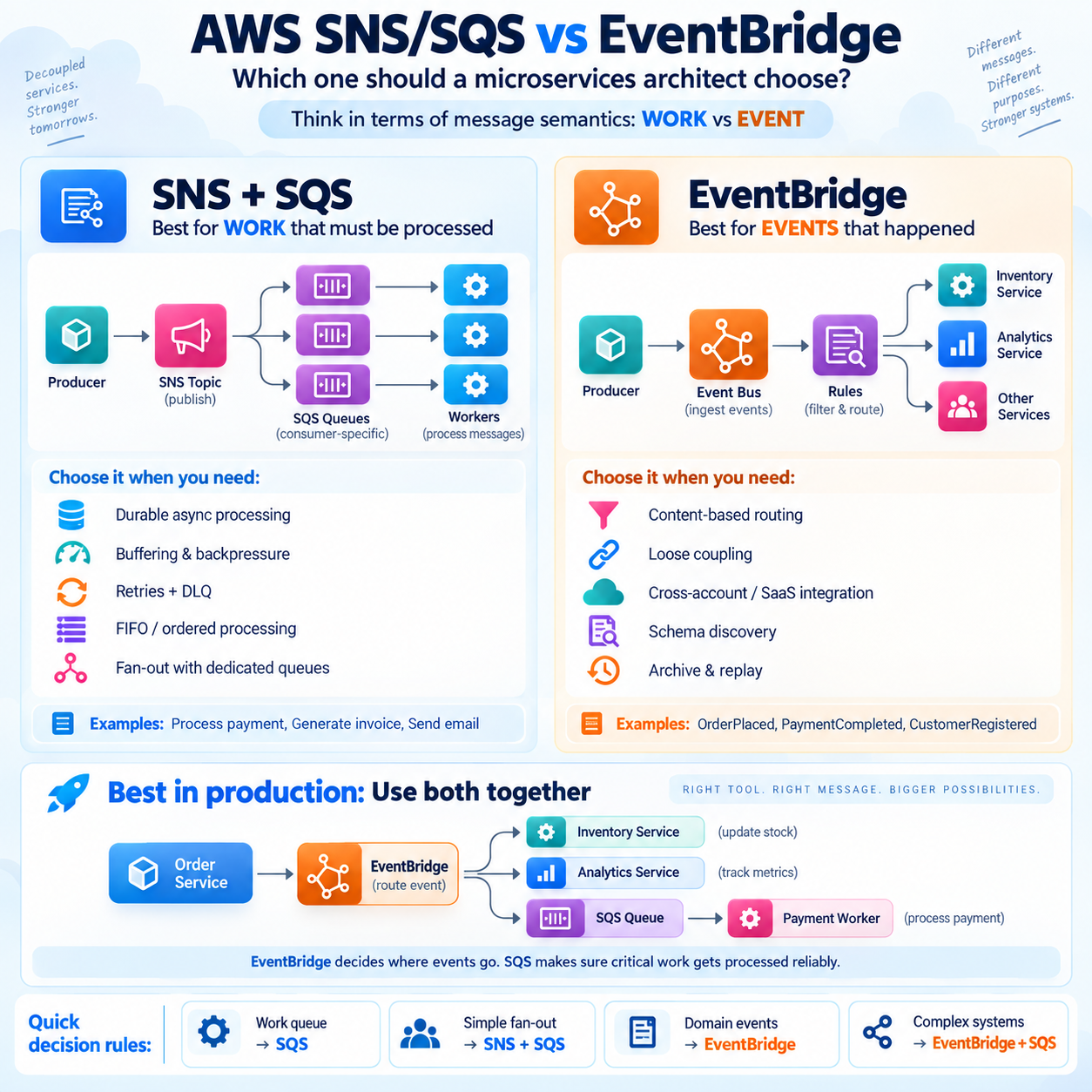
AWS SNS/SQS vs EventBridge: The Choice Every Microservices Architect Has to Make
When building event-driven microservices on AWS, one question comes up again and again:
👉 Should we use SNS + SQS, or EventBridge?
My rule of thumb is simple:
Are you sending WORK that must be processed, or announcing an EVENT that happened?
📦 Choose SNS + SQS when the message represents work that a consumer must reliably process.
Typical examples:
• Process this payment
• Generate this invoice
• Send this email
• Update this inventory record
• Process this order
SQS gives each consumer its own durable queue, allowing services to process messages independently and absorb traffic spikes.
It is especially useful when you need:
✅ Buffering and backpressure
✅ Independent consumer scaling
✅ Retry + Dead Letter Queues
✅ FIFO / ordered processing
✅ Reliable asynchronous workloads
SNS can sit in front of multiple SQS queues when the same message needs to fan out to several services.
📡 Choose EventBridge when the message represents a FACT that happened.
For example:
OrderPlaced
PaymentCompleted
CustomerRegistered
SubscriptionCancelled
The producer shouldn't need to know who consumes those events.
EventBridge becomes particularly powerful when you need:
✅ Content-based routing
✅ Many event producers and consumers
✅ Cross-account event distribution
✅ AWS service integrations
✅ SaaS integrations
✅ Schema discovery / registry
✅ Event archive and replay
Instead of:
Producer → specific consumers
you move toward:
Producer → Event Bus → rules → interested consumers
That creates much looser coupling.
But here's the important part:
🔥 SNS/SQS and EventBridge are not necessarily competitors.
A production architecture can use both.
For example:
Order Service
↓
OrderPlaced
↓
EventBridge
↙ ↓ ↘
Payments Inventory Analytics
↓
SQS
↓
Payment Worker
EventBridge decides where the event should go.
SQS makes sure the work gets processed reliably.
That's a very powerful combination.
So my architecture rule is:
📦 Command / Work Queue → SQS
📢 Simple Pub/Sub Fan-out → SNS + SQS
📡 Domain Events + Intelligent Routing → EventBridge
🏗️ Complex production microservices → EventBridge + SQS
The mistake is choosing one technology for every messaging problem.
Good microservices architecture starts with understanding the semantics of the message, not the AWS service.
How are you handling events in your AWS microservices architecture — SNS/SQS, EventBridge, or both?
#Microservices #AWS #EventDrivenArchitecture #SoftwareArchitecture #CloudArchitecture #AmazonSQS #AmazonSNS #AmazonEventBridge #DotNet #DistributedSystems