🚀 JavaScript vs. TypeScript in React: When Should You Use Each — and Why?
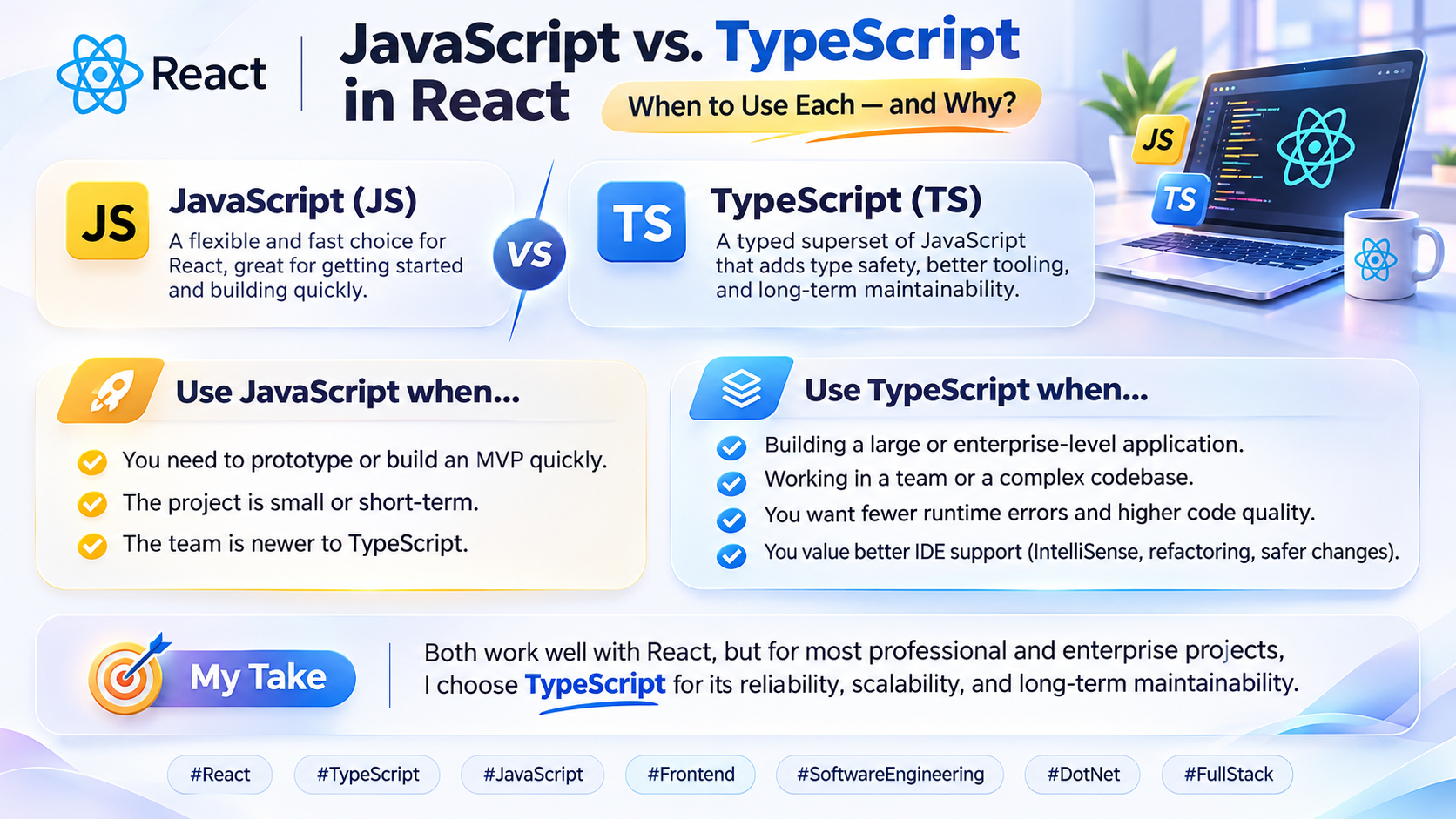
Both JavaScript and TypeScript are powerful choices for React development, but choosing the right one can make a big difference in scalability, maintainability, and developer productivity. JavaScript is great for quick prototypes and smaller projects, while TypeScript brings stronger type safety, better tooling, and easier refactoring to complex enterprise applications.
One question I often see in frontend development:
“If React works perfectly with JavaScript, why should we use TypeScript?”
My answer: It depends on the project's complexity, team size, and long-term maintainability.
Both JavaScript and TypeScript are excellent choices, but they solve different problems.
🟨 When JavaScript Makes Sense
✅ Small applications and quick prototypes
✅ Proof-of-concept (POC) development
✅ Projects with minimal data complexity
✅ Teams prioritizing rapid experimentation
JavaScript provides flexibility and a lower initial setup cost.
🔷 When TypeScript Is the Better Choice
✅ Large-scale enterprise applications
✅ Complex components, props, and state management
✅ Multiple developers working on shared code
✅ Long-term maintenance and refactoring
✅ Frontend integration with strongly typed backend APIs
TypeScript adds compile-time checks, better IDE support, and safer refactoring.
💡 Here's an important architectural consideration:
In enterprise applications using React + ASP.NET Core, TypeScript becomes particularly valuable.
Why?
Because we can generate TypeScript types from OpenAPI contracts, helping keep frontend models aligned with C# backend DTOs.
This reduces integration mistakes and improves maintainability across the full stack.
⚠️ But TypeScript isn't a silver bullet.
It doesn't validate runtime API responses automatically, eliminate architectural problems, or guarantee bug-free applications.
You still need runtime validation, testing, and well-designed component boundaries.
🎯 My perspective:
For a quick prototype, JavaScript is often sufficient.
For a production enterprise application expected to grow over several years, I'd generally choose TypeScript.
The best engineering decisions aren't about choosing the most popular technology.
They're about choosing the right trade-offs for the system you're building.
💬 What's your preference for React projects — JavaScript or TypeScript? And has TypeScript ever saved you from a production bug?
#React #TypeScript #JavaScript #SoftwareArchitecture #DotNet #ASPNetCore #FullStackDevelopment #SoftwareEngineering