Legacy System Modernization Is NOT Just “Code Migration”
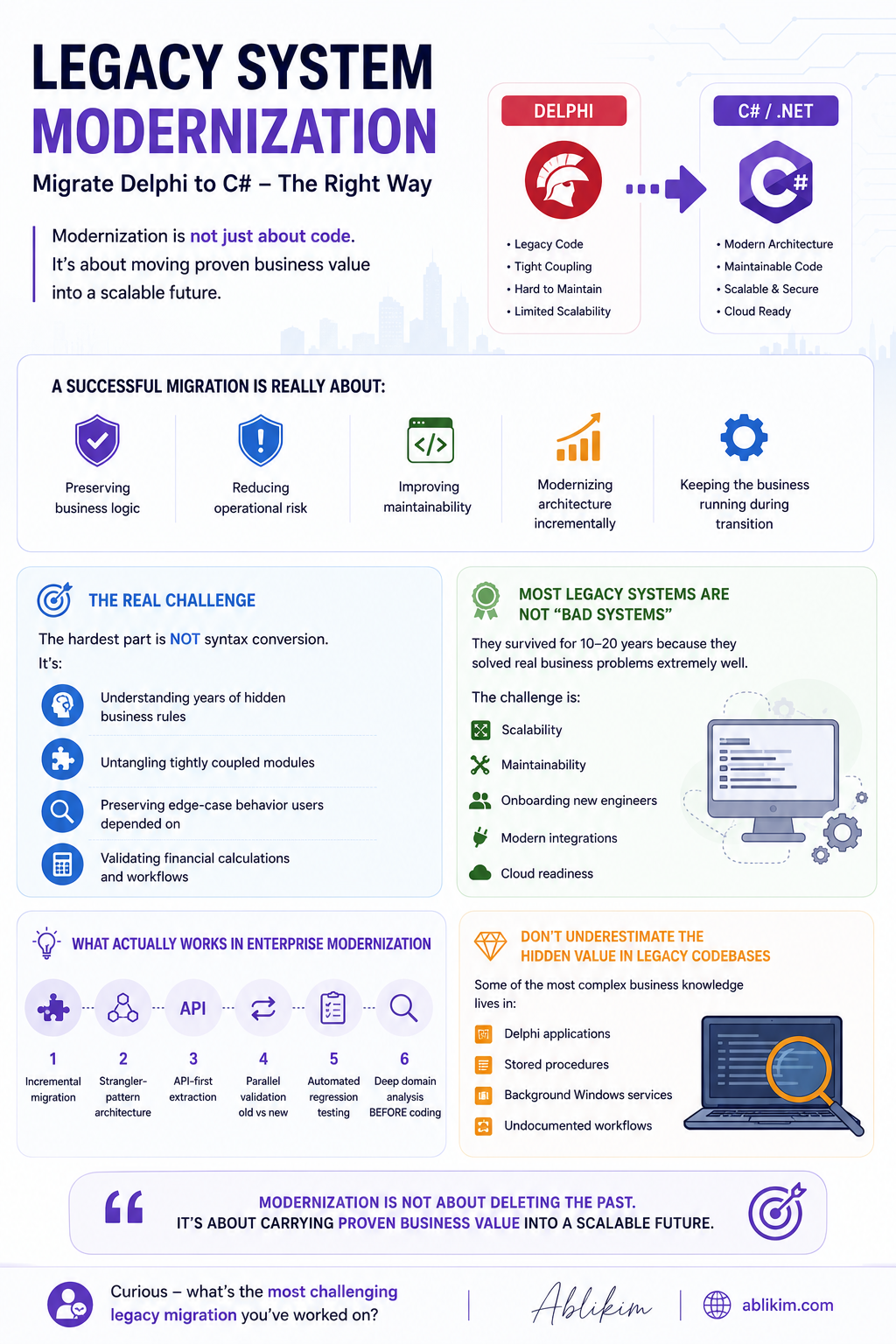
🚀 Legacy System Modernization Is NOT Just “Code Migration”
One of the biggest mistakes companies make when migrating legacy systems (Delphi, WinForms, VB6, older .NET, etc.) is treating modernization as a simple “rewrite project.”
It’s not.
🧠 A successful migration is really about:
✅ Preserving business logic
✅ Reducing operational risk
✅ Improving maintainability
✅ Modernizing architecture incrementally
✅ Keeping the business running during transition
💡 Recently, I worked on migrating a large legacy Delphi-based business platform into modern C#/.NET services.
The hardest part was NOT syntax conversion.
It was:
- understanding years of hidden business rules
- untangling tightly coupled modules
- preserving edge-case behavior users depended on
- validating financial calculations and workflows
⚠️ Most legacy systems are not “bad systems.”
In many cases:
👉 they survived for 10–20 years because they solved real business problems extremely well.
The challenge is:
- scalability
- maintainability
- onboarding new engineers
- modern integrations
- cloud readiness
🏗️ What actually works in enterprise modernization:
✔ Incremental migration
✔ Strangler-pattern architecture
✔ API-first extraction
✔ Parallel validation between old/new systems
✔ Automated regression testing
✔ Deep domain analysis BEFORE coding
🔥 Important lesson:
Never underestimate the value hidden inside legacy codebases.
Some of the most complex business knowledge in enterprises lives in:
- Delphi applications
- stored procedures
- background Windows services
- undocumented workflows
💬 Modernization is not about deleting the past.
It’s about carrying proven business value into a scalable future.
Curious — what’s the most challenging legacy migration you’ve worked on?
#DotNet #Delphi #SoftwareArchitecture #LegacyCode #CSharp #Modernization #SoftwareEngineering