The Most Expensive Line of Code in a Distributed System
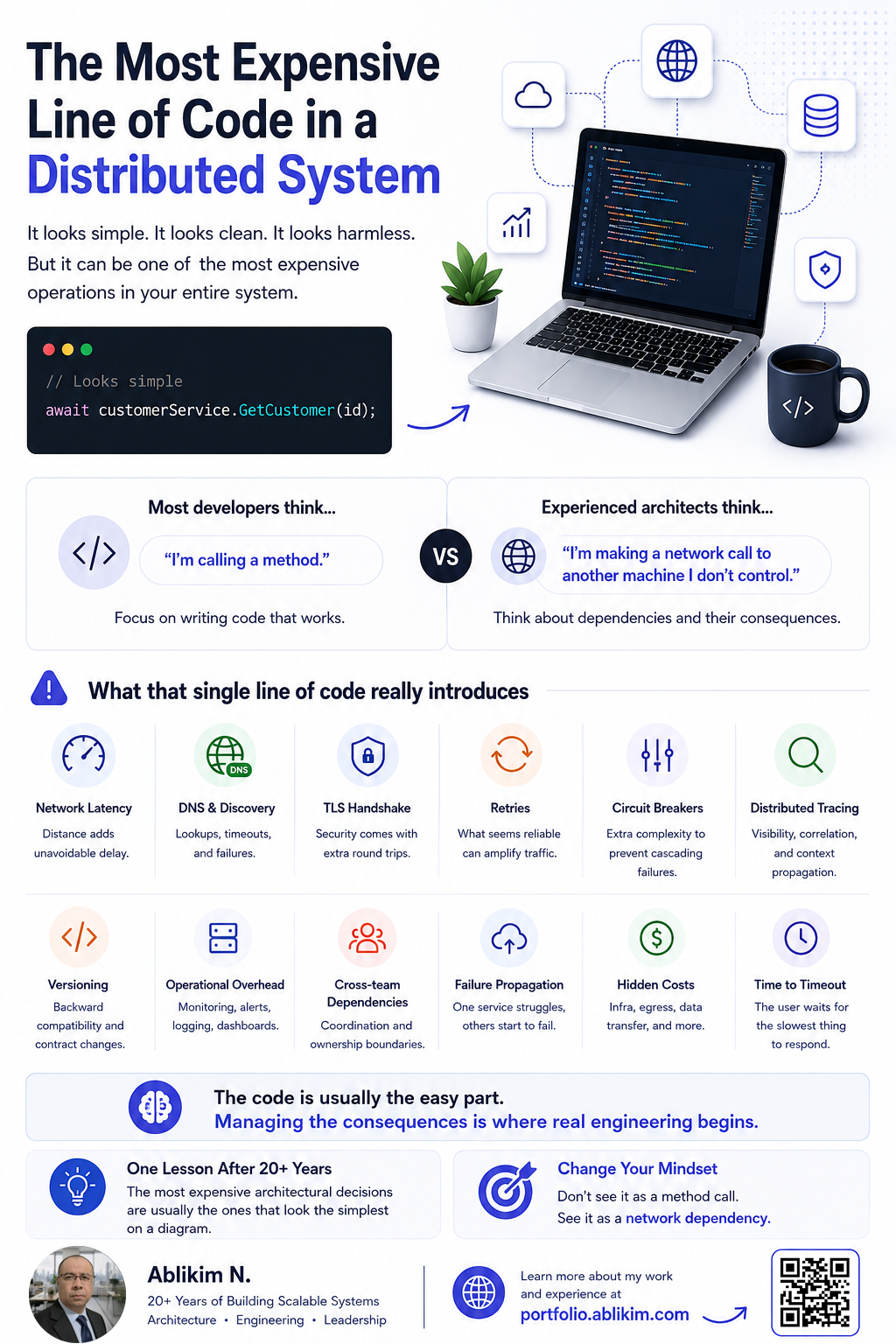
Most developers assume the expensive part of an application is the database query.
Sometimes it's actually this:
await customerService.GetCustomer(id);
Looks simple.
Looks clean.
Looks harmless.
But that single line may introduce:
• Network latency
• Service discovery lookups
• DNS resolution
• TLS handshakes
• Timeouts
• Retries
• Circuit breakers
• Distributed tracing requirements
• Versioning dependencies
• Cross-team ownership challenges
• Failure propagation across multiple services
In a monolith, a method call usually executes in microseconds.
In a distributed architecture, the same logical operation may take milliseconds—or fail entirely.
That's why experienced architects become very cautious whenever they hear:
"Let's just make it another microservice."
Because the hardest part of distributed systems isn't writing the code.
It's everything that happens between the code.
Every service boundary introduces operational complexity:
- More failure points
- More monitoring requirements
- More deployment coordination
- More debugging complexity
- More network uncertainty
The code itself is often the easy part.
Managing the consequences of that code is where the real engineering begins.
One lesson I've learned after 20+ years in software development:
The most expensive architectural decisions are usually the ones that look the simplest on a diagram.
The next time you see a service call, don't think of it as a method invocation.
Think of it as a network dependency.
That mindset alone can change how you design systems.
What's the smallest-looking line of code that caused the biggest production problem in your experience?
#SoftwareArchitecture #DistributedSystems #Microservices #SystemDesign #DotNet #SoftwareEngineering #CloudComputing #Architecture #TechLeadership #Engineering