Blazor Server at Scale: JS Interop Is a Boundary
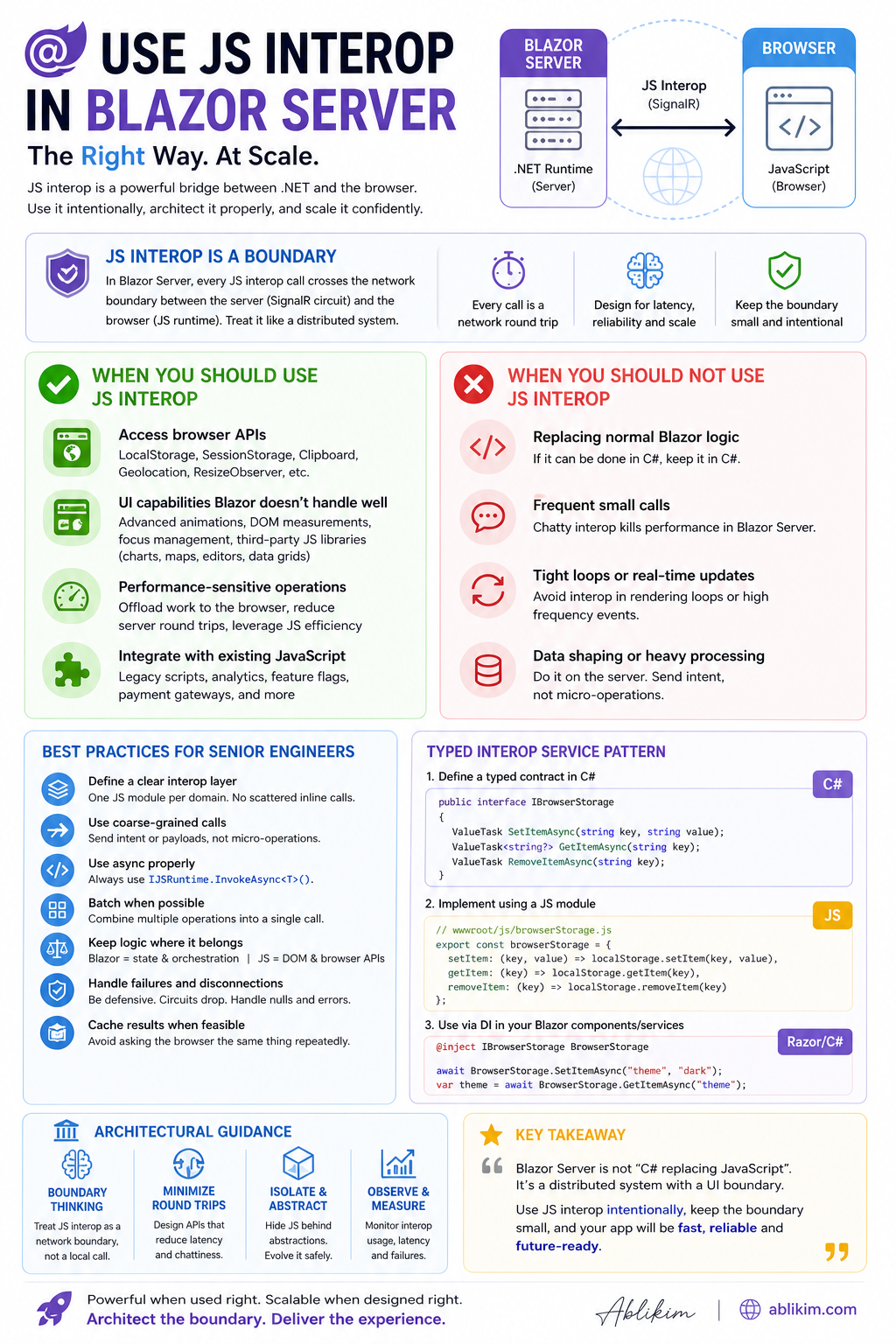
🧠 Blazor Server at Scale: JS Interop Is a Boundary — Treat It Like One
Most discussions about JS interop in Blazor Server focus on how to call JavaScript.
Senior engineers should focus on where the boundary lives — and why it matters.
🚧 In Blazor Server, JS interop is not just a feature.
👉 It is a network boundary between:
- Server-side state (SignalR circuit)
- Browser execution (DOM + JS runtime)
Every call crosses that boundary.
⚠️ What breaks at scale:
❌ High-frequency interop calls (UI jitter, latency amplification)
❌ Chatty patterns (multiple small calls instead of batching)
❌ Treating JS like a utility layer instead of a subsystem
👉 Result: degraded UX, unstable circuits, hard-to-debug issues
🏗️ Architect it properly:
✔ Define a clear interop layer
- One module per domain (storage, UI, analytics, etc.)
- No scattered inline JS calls
✔ Use coarse-grained calls
- Send intent, not micro-operations
- Prefer one structured payload over many calls
✔ Keep logic where it belongs:
- Blazor → state, orchestration
- JS → DOM, browser APIs, rendering concerns
⚙️ Performance strategy:
- Minimize round trips (critical in Blazor Server)
- Use client-side buffering where possible
- Avoid interop in rendering loops
- Cache results when feasible
🔐 Reliability considerations:
- Handle disconnections (circuit drops)
- Design idempotent JS calls
- Always guard against null DOM states
- Use defensive JS wrappers
🧩 Advanced pattern:
👉 Build a typed interop service
public interface IBrowserStorage
{
    ValueTask SetItemAsync(string key, string value);
    ValueTask<string?> GetItemAsync(string key);
}
👉 Backed by a JS module — not raw calls everywhere
💬 Key mindset shift:
Blazor Server is not “C# replacing JavaScript”
👉 It’s a distributed system with a UI boundary
And JS interop is where that boundary is enforced.
Curious — how are you structuring JS interop in your Blazor Server apps today?
#Blazor #DotNet #Architecture #SoftwareEngineering #DistributedSystems #CSharp